Progressive Web Applications (PWAs) are the next big thing in eCommerce. This topic has been on everyone’s lips and under everyone’s fingertips from the initial conversations around Magento 2 frontend and the introduction of the headless concept.
If you are a merchant considering this new frontend concept, you may be wondering what the fuss is all about, whether it makes sense to invest in PWAs, and how big of an investment should you plan? Here is a quick rundown of the main questions and answers for anyone still on the fence about PWAs in Magento, from a merchant’s perspective.
UPDATE: Read this to learn about our current approach to PWA
You may have been redirected to this page from Inchoo PWA Demo landing page. Read on to learn why we have made the switch and to see how we see the current state of PWA and Magento.
This post has been modified since its 1st version back in 2018. The post was originally written in late 2018 when we were invested in preparing a PWA Demo of our own, using PWA Studio as the foundation.
Since then, a lot of things have happened, some companies have doubled down on their efforts around PWA adoption and are actively presenting this as the only way forward. Others have tried and failed. Most are still on the fence.
We’ll give you our thoughts here.
Where is PWA now (June 2020)?
We can see some examples of PWA projects “out there”, some companies have had success, some (and you will not hear a lot of those stories) have failed and made a U-turn.
Why? Mostly because the promise of PWA did not match the reality. This all comes down to it being an option for two opposite sides of a bell curve.
1) It is a viable option for simpler, smaller stores that don’t have too many custom features or don’t rely heavily on many integrations with outside systems.
2) It can also be an option for larger merchants that want and can afford to adopt the decoupled, headless approach, and are looking to build a highly custom user experience.
For both of these cases, there are companies that will absorb a lot of the project delivery, bugfixing and maintenance costs because it is a learning process for them too, and merchants can find a good match with someone that can build the solution within a reasonable budget.
However, there are still inevitably going to be high maintenance costs and any custom solution (and most PWAs are exactly that) will not be compatible with future releases of Magento product, or other extensions a merchant is using. Thus – additional costs to manage the solution.
And this is all good if you want to be an early adopter, and are aware of these things, and have the investment budget to support it. However, we feel that there is a huge buzz around PWAs, making them look like they are solving a number of business problems, while the actual, field data, doesn’t support this.
We are having a number of solutions, with Vue Storefront leading the charge, and Deity, ScandiPWA and Front-Commerce following, that are, to an extent, productized.
And PWA Studio is not a solution itself, but rather a set of tools and good practices companies delivering the solution should follow.
Are we at the peak of inflated expectations?
This is a really nice visual by Gartner, Hype Cycles by Gartner are a great representation of maturity and adoption of technologies, and how they are relevant to solving business problems and exploiting new opportunities. I’ve used this in a LinkedIn post and had some really interesting comments, you can check them out here.
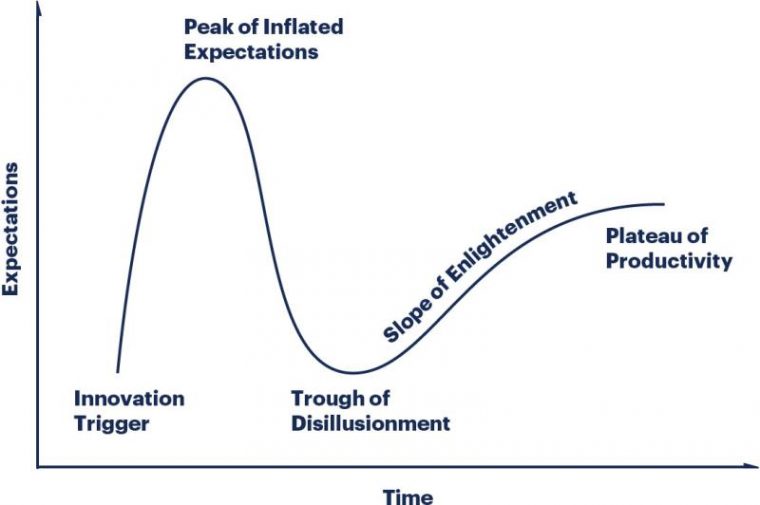
I would say that PWA is currently at the Peak of Inflated Expectations, and we are coming towards the Trough of Disillusionment. This is not to say anyone’s efforts are futile, but we should all be aware of this and act accordingly – communicate clearly towards merchants and be honest within the community.
There are companies leading the charge, and they should be recognized for their efforts. We all look forward to getting closer to the Slope of Enlightenment and Plateau of Productivity in the coming years.
And here is another interesting conversation to get a better understanding of the state of PWA these days (make sure to expand and go over the comments below the original tweet):
P.W.A.
— Willem_Wigman::tweets.phtml (@willemwigman) June 10, 2020
We're not there yet.
I do believe it's the future, but today, it's not great. pic.twitter.com/eEYKCB1KEx
Examples of PWA stores out there
Sander Mangel from Vue Storefront has prepared a showcase of PWA eCommerce websites “in the wild” – you can see it on his GitHub repo. Not all of those are on Magento, though, but you can see the technology behind each of them next to the links. If you know of others, please contribute. This is a good overview of what’s currently done with various PWA approaches and products.
Some real-life data to take into account
Erwin Hofman recently shared his findings after analyzing dozens of international PWA stores, based on the list mentioned in the previous paragraph. Check out his post, the findings and the comments in his LinkedIn post below:
Where do we stand?
You can see some of the comments our CEO Tomislav Bilic has made in his interview marking Inchoo’s 12th anniversary back in May this year. To quote him:
Progressive Web Applications (PWA) created huge interest, and Inchoo put a lot of effort into making a Magento PWA demo store. Is PWA the right choice for Magento clients?
Inchoo has a special love-hate relationship regarding that topic. When they first mentioned this concept, I thought it was interesting because of organizational and development goals. I wanted for the frontend team to develop their skills not only with Magento, so we could develop certain sectors in the company better.
The PWA concept today is pretty common on the web, and for some apps, it became a must-have, but it is challenging to implement it in a platform such as Magento. Magento PWA Studio is developing slower than expected, and as for other solutions, there isn’t a standardized, reliable one that we can count on. When making a PWA solution, it is not enough just to build it; you also need to connect it to the extensions, maintain and allow for it to be resistant for future Magento versions and upcoming changes. PWA brings high maintenance costs after the main build, and its financial weight is transferred onto the clients, which could lead to dissatisfaction, can compromise their business, and delay their further growth.
There was hype, and the clients thought those solutions were very attractive. There aren’t many articles about this topic, but a lot of clients started with implementing PWA, spent a lot of money, and later gave up on it. Of course, they came back to the standardized and safer way. We concluded that PWA solutions currently do not justify their high costs, and following a vision of Merchant’s Best Friend, we would like to suggest to the clients those solutions that we think are the best for them. Because of that, we do not promote PWA as the desired solution for Magento clients.
Below you’ll find the original post where we outlined some of the details about PWAs – most of these still apply, in theory at least.
But, as we mentioned above, the reality is that this technology, approach, however you want to call it, is still some way off being mature or ready for wider adoption by the merchants globally.
We are keeping our eyes open and will treat every lead/client with the same approach – looking to give recommendations that we feel are the best ones for their business.
Get in touch with us to talk about the next steps for your business. We promise we won’t over-promise. 🙂