A Brief No-BS Look Inside
Remember when chatbots were going to replace customer service reps, and then mostly just frustrated everyone for a few years?
We’re at a similar inflection point right now. The conversation has shifted from “AI that helps you shop” to “AI that shops for you,” which sounds great… until you realize nobody’s figured out how to collect sales tax on it.
At Inchoo, we’ve spent the last few months watching this space closely. Not from the sidelines, but from deep inside the Magento/Adobe Commerce ecosystem where our merchants operate every day.
We’ve been through the hype cycles of headless, social, metaverse, and voice commerce. We know what it looks like when something is real and when something is a board deck slide. Agentic commerce is different because parts of it are clearly, demonstrably real. But the gap between the hype and what’s actually working is wide enough to lose a few billion-dollar valuations in.
Here’s where things actually stand in Q1 2026, what the real opportunities are, and where you should be cautious.
The Protocol Wars (Explained Like You’re Not at a Conference)
Here’s where it gets interesting and complicated. There are now at least seven protocols competing to define how AI agents interact with commerce. Understanding this space is going to matter for anyone building online stores in the next few years.
UCP (Universal Commerce Protocol)
This is the one that matters most if you sell things online. Google built it with Shopify, Etsy, Walmart, Target, and Wayfair. Launched January 2026. Open, Apache 2.0, RESTful + JSON. It uses /.well-known/ucp for discovery, which (if you’ve worked with web standards) you’ll recognize as the conventional pattern. The design is decentralized: any AI agent can discover and transact with your store without asking Google’s permission.
It handles the full shopping journey: browse, compare, cart, checkout. Already live with Etsy and Wayfair inside Google’s AI Mode search. Think of it as another Google Shopping, another sales channel, another demand capture channel. You want to be on it.
ACP (Agentic Commerce Protocol)
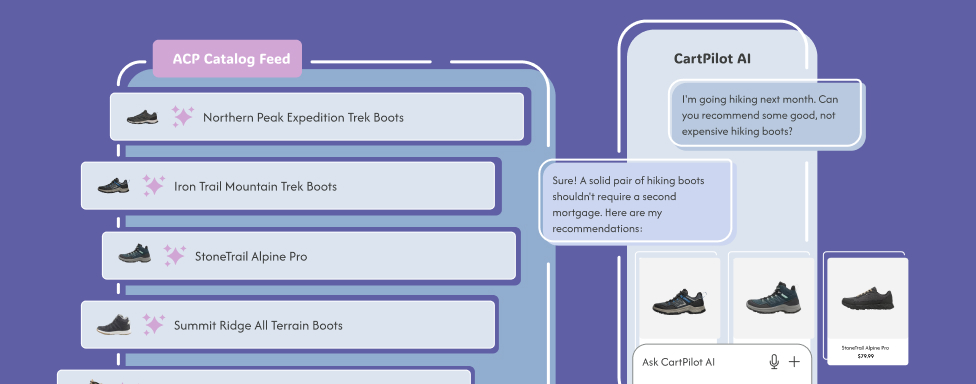
OpenAI + Stripe. Unlike UCP, discovery here is centralized: merchants apply through OpenAI, get approved, and products surface in ChatGPT. The protocol itself is technically sound and continues to be adopted. Microsoft built Copilot Checkout on it.
But OpenAI’s own flagship implementation, ChatGPT’s Instant Checkout, was pulled back in early March 2026 after low conversion rates and the discovery that they hadn’t built sales tax collection. Only about 12 out of over a million eligible Shopify sellers had actually integrated. The protocol lives on; the in-chat checkout experience does not.
MCP (Model Context Protocol)
Anthropic’s protocol for connecting AI models to tools and data. Not commerce-specific, but it’s become the plumbing underneath everything else. Every Shopify store already has an MCP endpoint at /api/mcp. Think of UCP as the storefront; MCP is the loading dock.
The Supporting Cast
- A2A (Agent-to-Agent): Also Google. Over 150 organizations involved. This isn’t about commerce specifically; it’s about how AI agents talk to each other. HTTP, Server-Sent Events, JSON-RPC. If you squint, you can see a future where your personal shopping agent negotiates with a retailer’s inventory agent using this.
- AP2 (Agentic Payments Protocol): Google again, with about 60 companies. Cryptographic payment mandates. Payment-processor agnostic, which is smart: it’s not tied to Stripe or any single provider.
- x402: Coinbase and Cloudflare. Uses the HTTP 402 status code (which has been “reserved for future use” since 1999). Stablecoin micropayments. Over 75 million transactions processed, though CoinDesk reports daily dollar volume remains modest, suggesting most activity is testing and true micropayments rather than mainstream commerce. It proved that machine-to-machine payments over HTTP could work.
- MPP (Machine Payments Protocol). Stripe and Tempo. Launched March 18, 2026, literally this week. Uses the same HTTP 402 status code as x402 but adds card payments, stablecoins, and Lightning alongside custom payment rails. Has transport bindings for MCP, so any MCP server can charge for tool calls, which is new. Already live with launch partners processing real transactions. On the IETF standards track.
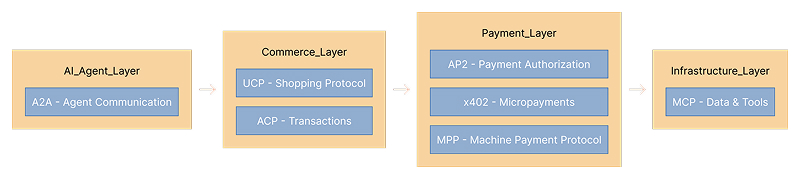
What’s emerging is a layered stack: MCP for tools and data, A2A for agent communication, UCP for the shopping journey, ACP for transactions, MPP for machine-to-machine payments, AP2 for payment authorization. It’s elegant on a whiteboard. In practice, nobody is running the full stack today.
The audience is already there, though. ChatGPT crossed 900 million weekly users in February 2026. Gemini passed 750 million monthly. That’s a lot of people whose AI assistants can now shop for them.
The Hard Problems
Attribution Is Blind

When a customer discovers your product inside ChatGPT, compares it in Gemini, and has an agent complete the purchase, who gets attribution credit? Right now, mostly nobody.
The discovery happens inside AI systems that are invisible to your analytics. Your UTM parameters, your first-touch/last-touch models, your carefully tuned ad spend, none of that works when an AI agent is the intermediary. And if you can’t measure where customers are coming from, you can’t allocate spend rationally.
Brand Erosion
BCG (Boston Consulting Group) has warned that brands risk becoming “background utilities”: fulfillment engines that AI agents select based on price and availability, with zero brand equity or customer relationship. If an agent picks your product because it’s $2 cheaper and in stock, you haven’t won a customer. You’ve won a transaction.
The difference matters for lifetime value. You’re a row in a comparison table, and for brand-driven commerce, that’s a problem nobody has a good answer to yet.
Regulation Is Coming
The EU AI Act hits in August 2026 with fines up to 7% of global revenue. That’s not a typo. For context, GDPR caps at 4%. If you’re building agentic commerce features for European markets, you need to be thinking about compliance off the bat.
The Adobe Problem
On February 18, 2026, Adobe announced support for UCP and ACP. Great news, right? Except they didn’t ship anything. It’s a commitment, not a feature. No native protocol support. No MCP endpoint. No toggle. Just a press release.
Meanwhile, Shopify merchants got MCP endpoints nine months ago and agentic storefronts with a single toggle in their Winter ’26 release.
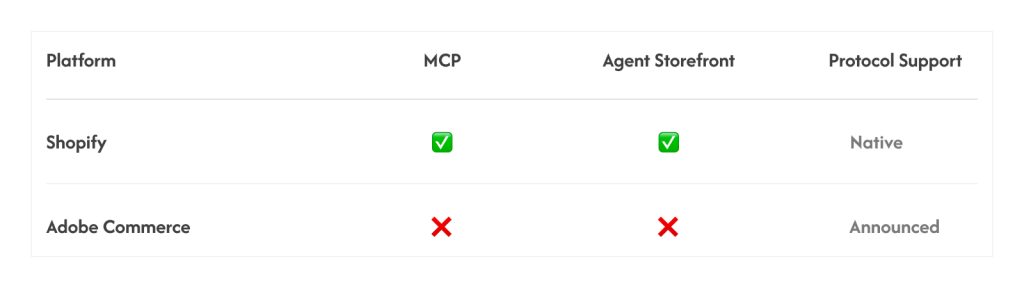
We work with Magento/Adobe Commerce every day. It’s a powerful platform for complex B2B, for businesses that need deep customization, for merchants with genuinely complicated catalog and pricing requirements. We’re not going to pretend otherwise.
But this gap is real and it’s concerning. If you’re on Magento/Adobe Commerce and want to participate in agentic commerce, you’re looking at custom solutions. The good news: custom solutions are where this platform has always excelled. The bad news: you shouldn’t have to build what other platforms give you for free.
The Bigger Picture
McKinsey projects that agentic commerce could drive up to $1 trillion in US B2C retail by 2030, and $3-5 trillion globally.
The companies moving fastest (Shopify, Amazon, Google) are doing so with massive resources and tightly controlled ecosystems. Amazon’s consumer commerce AI (Rufus and Alexa+) is entirely proprietary. They’re not adopting UCP, ACP, or any open commerce protocol, which tells you something about how the largest player views standardization.
For mid-market merchants on platforms like Magento/Adobe Commerce, the play is not to lead the charge. It’s to prepare intelligently, invest in fundamentals that pay off regardless of which protocols win, and stay close to partners who are tracking these developments daily.
What Should Merchants Actually Do Right Now?
1. Get your product data in order.
Every agentic commerce protocol relies on structured, accurate, rich product data. If your catalog has inconsistent attributes, missing descriptions, or poor categorization, no protocol integration will save you. Build for structured data exposure that works across multiple protocols (MCP + UCP + ACP) rather than deep integration with any single one. This is the single highest-ROI preparation step you can currently take.
2. Understand the conversion reality.
According to Adobe, AI referrals convert 31% higher and generate 254% more revenue per visit. But only 24% of US consumers are currently comfortable purchasing through AI. The opportunity is real, but the audience is still early-adopter territory.
3. Instrument your AI traffic and manage your bots.
Set up tracking for AI-referred traffic now, even if it’s imperfect. You need a baseline. The most popular analytics platforms (GA, Plausible Analytics, et al) already support AI traffic segmentation. Use it.
Note: some agents don’t publish their identity, making full attribution difficult.
On the bot side, we’re seeing websites getting absolutely hammered. Set up proper rules in your chosen SOC and make sure you’re not outright blocking all bot traffic, because that will kill your visibility in agentic commerce off the bat.
Keep your robots.txt up to date. (It remains to be seen whether llms.txt will stick around.)
4. Don’t rip and replace your storefront strategy.
Your website remains the destination. Even OpenAI is now redirecting shoppers to retailer sites rather than trying to handle checkout natively. Invest in your store experience; it will be the landing pad for agent-referred traffic.
5. Watch the fraud angle.
Fraudsters are already manipulating agentic shopping results, and agents have been deceived by counterfeit merchants. As this channel grows, so will the attack surface. Factor security into your agentic commerce plans from the start.
Where This Is Actually Going
Agentic commerce won’t replace traditional eCommerce. Not in 2026, not in 2030. What it will do is create a parallel channel that captures an increasing share of transactions, probably 15-25% of online commerce by 2028, heavily concentrated in commodity categories where brand differentiation is low and price comparison is straightforward.
These shifts can tip fast. Mobile commerce went from “nobody wants to buy on a tiny screen” to the majority of ecommerce in five years.
The merchants who thrive will be the ones who treat this as a serious channel requiring real investment. Not the ones who chase every protocol announcement, and not the ones who dismiss it as hype because the early implementations are clumsy. OpenAI pulling back Instant Checkout isn’t evidence that agentic commerce is failing. It’s evidence that it’s following the normal trajectory of transformative technology: messy, uneven, and inevitable.
The protocols will consolidate. The tax and fraud problems will get solved by the payment processors, who have the most to gain from making agent transactions work. Stripe shipped its Machine Payments Protocol this week, and they’re not the only ones moving. Trust will build slowly, the way it always does, one successful transaction at a time.
The question for merchants isn’t whether to engage with agentic commerce. It’s whether to engage thoughtfully now or scramble to catch up later.
At Inchoo, we’re helping Magento and Adobe Commerce merchants navigate this transition, from product data optimization to protocol readiness to the strategic decisions that will shape how your store performs in an agent-driven world. If you’re thinking through any of this for your business, we’d genuinely enjoy the conversation. Get in touch.