Here’s a fun fact: the average inbox receives over 120 emails a day. So yeah, getting into someone’s inbox is the easy part. Getting them to actually open, read, and click? That’s where most eCommerce brands fail.
The thing is, newsletters are one of the few marketing channels that no algorithm can take away from you. Unlike social media, where your post might reach a few % of your followers on a good day, an email lands right where you sent it. And with 93% of consumers preferring email over any other digital channel for brand communications, the inbox is still very much the place to be.
So let’s fix that. Whether you’re just getting started or trying to breathe life into underperforming campaigns, here’s everything you need to craft newsletters that connect and convert.
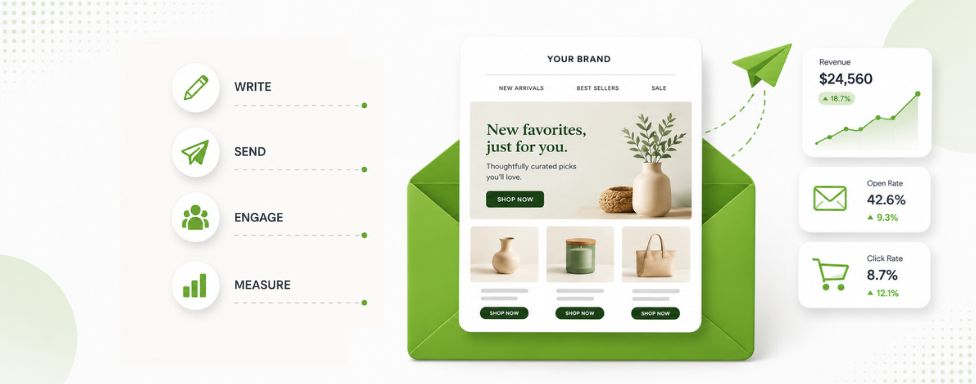
The 4 Elements Every Newsletter Needs
Before we get into tactics, let’s cover the basics. These are the four crew members every email needs on board. If one’s slacking, the whole campaign suffers.
Subject line
Your one shot to stand out. Most people will only ever see this part of your email.
Body content
Inform, entertain, or solve a problem (ideally all three at once).
Visuals
Layout and imagery shape how your email feels before a single word is read.
CTA button
Buttons outperform text links by up to 28%. Make it obvious. Make it clickable.
Writing Emails People Actually Want to Read
Here’s the mindset shift that changes everything:
stop writing emails, start having conversations.
A great subject line balances intrigue and relevance: a light touch of humor, a well-placed emoji, or a hint of FOMO can go a long way. The one rule? Never sacrifice clarity for cleverness. If someone has to re-read your subject line to figure out what it means, you’ve already lost them.
Once they’re in, write like you know who you’re talking to. For eCommerce, the emails that consistently perform best do one of three things:
Educate
Tips, guides, how-tos that help customers get more from your products.
Inspire
Curated picks, seasonal ideas, “shop the look” content that sparks desire.
Convert
Promotions, restocks, abandoned cart follow-ups, loyalty rewards.
A quick word on AI: yes, tools like ChatGPT or Claude can help with brainstorming, drafting, or getting unstuck. Nothing wrong with that. Just make sure the final version actually sounds like you. Readers can smell a generic AI email from a mile away, and it doesn’t exactly scream “we care about you.”
Design That Works
Content may be king, but a poorly designed email will dethrone it fast.
You don’t need to reinvent the wheel, most email platforms offer solid templates. What you do need is consistency: your brand colors, fonts, and visual style should be immediately recognizable. If someone sees your email without a sender name, they should still know it’s you.
A few things that make a measurable difference:
- White space is your friend. A clean, breathable layout keeps readers focused and reduces the urge to scroll past everything.
- CTA buttons, not text links. A proper button can boost conversions by up to 28%. Make it obvious. Make it clickable. Don’t make your designer get too creative here.
- Mobile-first layout. More than half of all emails are opened on mobile. If your layout breaks on a smaller screen, so does your conversion rate.
When to Send?
Timing is one of those things that feels like a small detail until you realize you’ve been emailing 30.000 people at 11 PM on a Friday.
The general wisdom:
avoid Mondays and Fridays
Monday inboxes are chaos, and Friday readers have mentally clocked out. Beyond that, the best time to send is whatever time your audience is most likely to open, and that’s something you find out through testing, not guessing.
For us, Tuesday mornings consistently win. But we also work with eCommerce clients whose audiences respond better on Thursday afternoons, or Wednesday evenings. The point: test at least 3-4 different day/time combinations across a few weeks before drawing conclusions.
And please, always account for time zones. If you have a global list, segment it or use a send-time optimization feature.
What Does “Success” Actually Look Like?
If you thought we were done, think again 😀. Now it’s time to get real.
You’ve crafted a great email. You’ve hit send. Now what?
Before measuring success, you need to know what you’re measuring it against. Here are the core KPIs every eCommerce newsletter should track, along with rough benchmarks so you know what “normal” looks like:
| Metric | What it tells you | Benchmark |
|---|---|---|
| Open rate | Subject line strength + list health | 20–35% |
| Click-through rate | Content and CTA relevance | 2–5% |
| Conversion rate | Email-to-purchase effectiveness | 1–3% |
| Revenue per email | Real commercial impact | Varies |
| Unsubscribe rate | Content–audience fit | < 0.5% |
A word on open rates: they’re a useful starting signal, but don’t get hypnotized by them. An open rate of 40% means nothing if nobody’s clicking. What you really want to see is the chain: opens → clicks → conversions.
To make it concrete: say you send a campaign to 2,000 subscribers. 500 open it (25%, solid). 100 click through (10% CTR. great). 20 make a purchase at an average order value of €75. That’s €1,500 in revenue from one email, and a revenue per email of €0.75.
Ask yourself: Why are we sending this newsletter? If it’s for awareness, it’s okay to focus on the open rate. But if you want conversions, you’ll need to consider more factors.
Start by understanding industry benchmarks – knowing what’s typical for your niche can help set realistic targets. If you’re new to newsletters, begin with simple goals like gradually increasing your KPIs over a few months. Focus on learning what resonates with your audience by testing different subject lines, content formats, and sending times.
Once you’re comfortable, refine your strategy by setting more specific goals, such as increasing subscriber engagement or conversion rates by xy%. Remember, it’s a journey of continuous improvement, so adjust your goals based on what you learn along the way.
Quick Checklist Before You Hit Send
Use this before every campaign goes out (your future self will thank you).
Ready? Go Build Something Worth Opening.
Newsletters work. Not because email is magic, but because a well-crafted message sent to the right person at the right time still outperforms most other marketing channels in eCommerce.
Don’t stress about getting it perfect on the first send. The more you experiment, the more you’ll learn, and the better your results will get.
Now go on, craft those emails, hit that send button, and watch your efforts pay off. If you find yourself struggling, don’t worry. Drop us a line, we’d love to help.