For many merchants, Facebook and Instagram are already important marketing channels. Customers discover products, follow brands, ask questions, save ideas, and often make purchase decisions there before they ever visit an online store.
However, there is a big difference between simply posting product photos on social media and properly connecting your eCommerce catalog with Meta.
That is where Meta Commerce Manager comes in.
Meta Commerce Manager is the tool that helps merchants manage their product presence across Facebook and Instagram. It allows you to create and manage a product catalog, organize collections, make products available for shopping experiences, and use accurate product data in Meta advertising campaigns. For merchants who do not yet use Meta as a commerce channel, Commerce Manager can be the first practical step toward turning Facebook and Instagram from communication channels into product discovery and sales channels.
OK, so what is Meta Commerce Manager?
Meta Commerce Manager is a platform within Meta’s business ecosystem that helps businesses manage their product catalog and shopping setup for Facebook and Instagram.
In simple terms, it is the place where Meta stores and manages the product data that can later be used across different Meta surfaces: Facebook Shops, Instagram Shopping, product tags, catalog ads, dynamic remarketing, and other commerce-related experiences.

A product catalog inside Meta can include information such as product names, descriptions, prices, images, availability, product URLs, variants, and other product attributes. Once that data is correctly connected, Meta can use it to display products to potential customers in a more structured and relevant way.
For a merchant, this means that Facebook and Instagram no longer need to be used only for brand awareness or generic advertising. They can become channels where customers discover specific products, browse collections, interact with product tags, and continue their buying journey.
Why should merchants care about Meta Commerce Manager?
The main reason is simple: your customers are already spending time on Facebook and Instagram.
People use these platforms for entertainment, inspiration, communication, and product discovery. In many industries, especially fashion, beauty, home, lifestyle, sports, food, gifts, accessories, and consumer electronics, the buying journey often starts with a social media impression.
A customer may first notice a product in a Reel, see it again in a remarketing ad, open the brand’s Instagram profile, browse tagged products, compare similar items, and only then visit the online store.
Without a properly connected catalog, this journey is harder to manage. Your marketing team may need to create manual campaigns, manually upload product data, or promote products without reliable information about price, stock, and availability.
With Meta Commerce Manager, the product catalog becomes a structured bridge between your eCommerce platform and Meta’s advertising and shopping ecosystem.

What can Meta Commerce Manager do?
Meta Commerce Manager gives merchants several practical capabilities.
- The most important one is product catalog management. You can create a catalog of products that you want to promote or make available on Facebook and Instagram. This catalog becomes the foundation for product tags, collections, catalog ads, and remarketing campaigns.
- It also helps with product availability and inventory information. When the catalog is properly synchronized with your online store, Meta can receive updated information about prices, stock status, product descriptions, and product images. This reduces the risk of promoting products that are out of stock or showing outdated prices.
- Another important benefit is advertising. Once your catalog is available in Meta, you can use it for more relevant campaigns. Instead of creating ads manually for individual products, you can use catalog-based campaigns where Meta dynamically shows products to users based on their behavior, interests, or previous interaction with your store.
- Commerce Manager also gives your marketing team a more centralized place to work with products inside Meta. They can organize collections, review catalog issues, manage shop settings, and better understand how product data is being used across Facebook and Instagram.
How does the shopping experience work on Facebook and Instagram?
The shopping experience on Facebook and Instagram is different from the experience in a traditional online store. In a classic eCommerce journey, the customer usually visits your website, browses categories, opens product pages, adds items to the cart, and completes checkout. The online store is the central environment where the merchant controls the full experience.
On Facebook and Instagram, the journey is more discovery-driven. A customer may see a product in a post, story, reel, ad, or profile shop. Instead of starting with a search or category page, the customer often starts with content.
This is why Meta can be especially valuable for products that are visually appealing, easy to understand, and suitable for impulse discovery or inspiration-led buying.
However, merchants should not think of Meta as a full replacement for their online store. For most businesses, the online store should remain the central place for product information, checkout, customer accounts, promotions, analytics, and long-term customer experience.
Meta should be understood as an additional sales and discovery layer. It helps bring products closer to customers inside Facebook and Instagram, while the eCommerce platform remains the operational backbone.
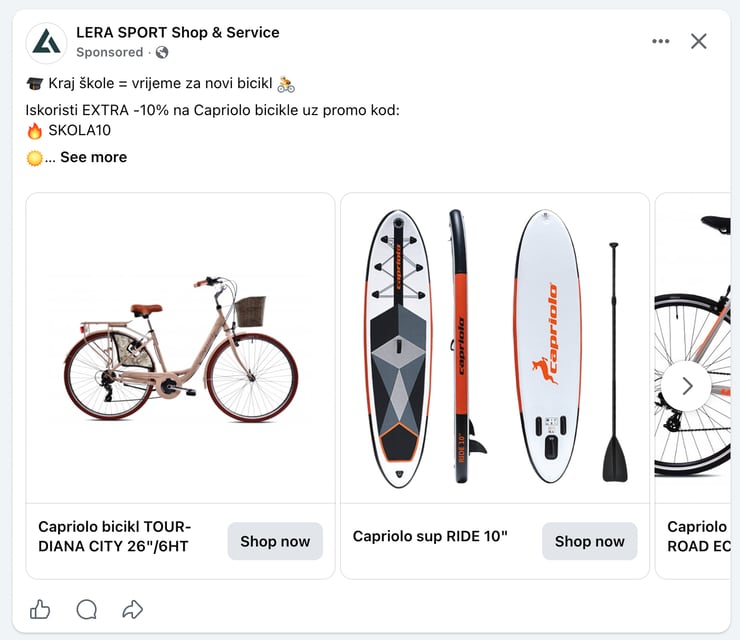
Meta Advertising with Meta Commerce Manager on Lera Sport
Is Meta Commerce Manager right for every merchant?
Meta Commerce Manager can be very useful, but it is not equally important for every type of business.
- It is usually a strong fit for merchants with consumer-facing products, strong visual presentation, active social media communication, and a catalog that can be promoted through product-based campaigns.
- It can be especially useful for merchants selling fashion, cosmetics, accessories, home decor, gifts, sports equipment, toys, food products, electronics, and similar categories where visual discovery plays an important role.
- It may be less suitable as a primary sales channel for businesses with very complex B2B buying processes, highly customized checkout flows, negotiated pricing, quote-based purchasing, or products that require a lot of technical explanation before purchase.
That does not mean such businesses cannot benefit from Meta. They can still use Meta for awareness, remarketing, product discovery, and lead generation. But they should be realistic about the role Meta plays in the overall buying journey.
Why catalog quality matters
The success of Meta Commerce Manager depends heavily on catalog quality.
If your catalog contains outdated product names, poor images, missing prices, incorrect stock information, or weak descriptions, your campaigns will suffer. Customers may see irrelevant products, click on unavailable items, or lose trust because the information shown on Meta does not match the online store.
That is why the technical connection between your eCommerce platform and Meta is important.
A good integration should keep product data accurate and up to date. Price changes, stock changes, product updates, and new products should be reflected in Meta without manual work. The marketing team should not have to depend on developers every time they need an updated product feed.
For merchants with larger catalogs, manual export and upload processes quickly become inefficient. They can also create unnecessary server load, especially if large CSV or XML feeds are generated frequently. A better approach is to use a proper integration that keeps the Meta catalog updated with less manual work and more reliable product data.
Meta Commerce Manager and Magento Open Source
For merchants using Magento Open Source or Adobe Commerce, Meta Commerce Manager can become a valuable addition to the eCommerce ecosystem.
Magento should remain the central place for managing products, prices, stock, categories, orders, and the core shopping experience. Meta Commerce Manager should then receive the right product data from Magento and use it across Facebook and Instagram.
This setup gives merchants the best of both worlds.
Magento remains the source of truth for eCommerce operations, while Meta becomes a powerful channel for discovery, advertising, remarketing, and social shopping.
A well-configured Magento and Meta integration can support automatic product synchronization, more accurate catalog campaigns, better product availability data, and a more efficient workflow for the marketing team.
Instead of maintaining separate product data for Meta, the merchant can manage the catalog in Magento and let the integration keep Meta updated.
What should a good Magento and Meta integration include?
A practical integration should cover several areas.
- First, it should securely connect Magento with the merchant’s Meta Business account and Commerce Manager setup. This includes authentication, permissions, and the correct connection between Magento, the Meta catalog, Facebook, and Instagram.
- Second, it should synchronize the product catalog. Product names, descriptions, prices, images, availability, product URLs, and selected categories or products should be transferred from Magento to Meta in a reliable way.
- Third, it should support the marketing team. The goal is not only to “send a feed” but to create a usable foundation for campaigns, remarketing, and catalog-based advertising.
- Fourth, it should respect analytics and consent requirements. In many cases, catalog synchronization and marketing event tracking should be treated as separate topics. Product synchronization can be handled by the Meta integration, while conversion tracking, remarketing events, and purchase events can be managed through a proper GTM setup. This allows better control over data granularity, consent mode, and event quality.
- Finally, the integration should include testing and debugging. A broken catalog connection can create real business problems: wrong prices, missing products, rejected items, campaign issues, or poor ad performance. Proper setup matters.
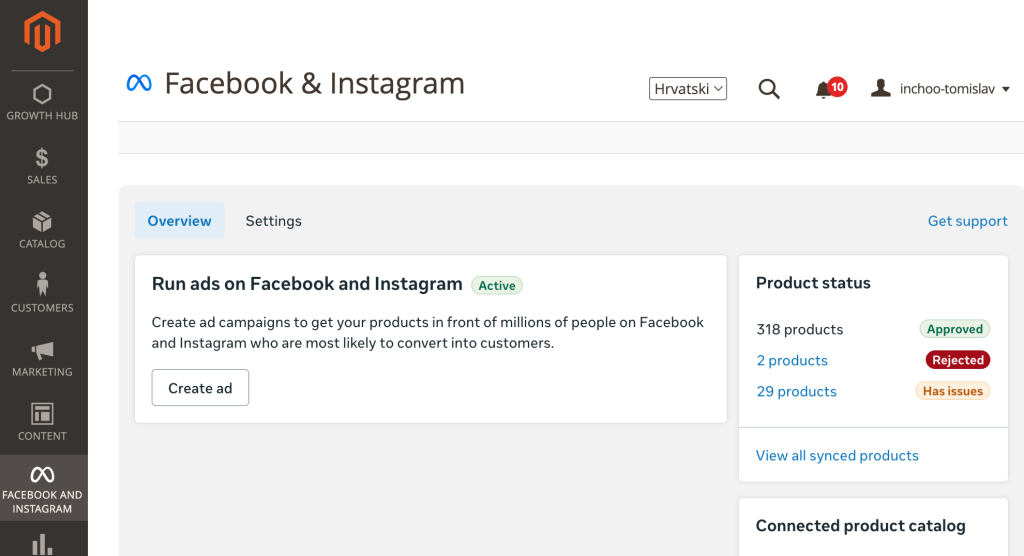
A practical solution for Magento Open Source merchants
At Inchoo, we help Magento Open Source and Adobe Commerce merchants connect their stores with Meta Commerce Manager in a practical and controlled way.
The goal is to enable automatic product synchronization between Magento and Meta, reduce manual catalog work, improve product data accuracy, and give the marketing team a stronger foundation for Facebook and Instagram campaigns.
For merchants using our eCommerce Accelerator Hootify, this can be especially useful. Hootify is built on Magento Open Source and the Hyvä frontend framework, with a strong focus on performance, maintainability, and practical eCommerce growth. Adding Meta Commerce Manager integration to this foundation allows merchants to extend their product reach into Facebook and Instagram while keeping Magento as the central system for catalog and sales management.
This means that merchants can start using Meta more seriously without turning it into a disconnected side project. Products remain managed in Magento. Meta receives accurate catalog data. Marketing teams get better tools for product promotion. Customers get a smoother product discovery experience across Facebook, Instagram, and the online store.
Final thoughts
Meta Commerce Manager is not just another social media tool. For merchants, it can be an important part of the modern eCommerce channel mix.
It helps connect your product catalog with the places where customers already spend time, discover products, and interact with brands. When properly integrated with Magento Open Source, it can support better catalog ads, more accurate product promotion, and a smoother path from discovery to purchase.
For merchants who do not yet use Meta as a commerce channel, the best first step is to build the right technical foundation: a clean catalog, a reliable Magento integration, a proper Meta Business setup, and a measurement approach that respects both campaign performance and consent requirements.
Magento Open Source, including Inchoo’s Hootify eCommerce Accelerator, can provide that foundation. With the right setup, Facebook and Instagram can become more than communication channels. They can become structured, measurable, and valuable product discovery channels connected directly to your eCommerce platform.
Here are some projects where we set successfully connected Magento with Meta Commerce Manager.