Some products in eCommerce don’t belong to standard product listings. Exclusive items like match worn jerseys, signed memorabilia, or limited edition collectibles cannot be restocked. When something is truly one of a kind, a fixed price usually leaves money, or excitement, on the table.
That is where auctions make sense. Instead of guessing the right price, you let customers decide what the item is worth through bidding.
One of our clients, HNK Hajduk Split, sits on a goldmine of these exclusive items. When they approved the idea of auctions, we did not bolt on a third-party widget or send fans to an external platform. We built an integrated live auction system directly into their Magento store.
This is the story of what we built, what happened when we launched it, and why live auctions may be one of the most underused tools in eCommerce.
From a Nice Idea to Real Requirements
The concept sounded simple. The implementation was a bit more complex.
A few principles were clear from the start:
- Trust is non-negotiable: Customers must feel the auction is fair. No one should ever be outbid in a way that feels manipulated.
- It has to be real-time: Refreshing a page to check the current price is not an auction.
- It has to live inside the existing store: Customers shop on the online store. Sending them elsewhere would fragment the experience.
- Merchants need to have authority: No developer should be required to launch a new auction.
What We Built
These principles dictated the architecture. Here’s what our Magento auction system includes:

Proxy Bidding
We implemented proxy bidding, a model familiar from major auction platforms like eBay. Users enter the maximum they are willing to pay. The system automatically bids only what is necessary to stay ahead. The maximum remains hidden. The final price becomes the second-highest maximum plus one increment. Not someone’s secret ceiling.

Real-Time Updates
The countdown timer, the current price, and the bid history update live. As the auction approaches its final minutes, update frequency increases. The tension stays where it should.

Living Inside the Store
We built auctions as a custom product type inside Magento. Auction products appear alongside regular merchandise in category listings. They share the same infrastructure and are indexed by search engines with proper structured data.

Admin Control
Through the admin panel, store managers can create an auction product, define start and end times, set a starting price and bid increment, and launch. Cron jobs manage status transitions. No developer involvement required to launch a new auction.

Automated Workflow
Automated emails notify bidders when they are outbid, when the auction ends, and when they win. The system also transitions products to finished state and marks them out of stock once the winner is determined.
Case Study: Hajduk Split Online Store
February 9th, 2026 was the debut for both us and our client. The first live run of our auction system, and Hajduk Split’s first ever auction: a match-worn jersey from Rokas Pukštas.
The starting price was intentionally low to encourage participation.
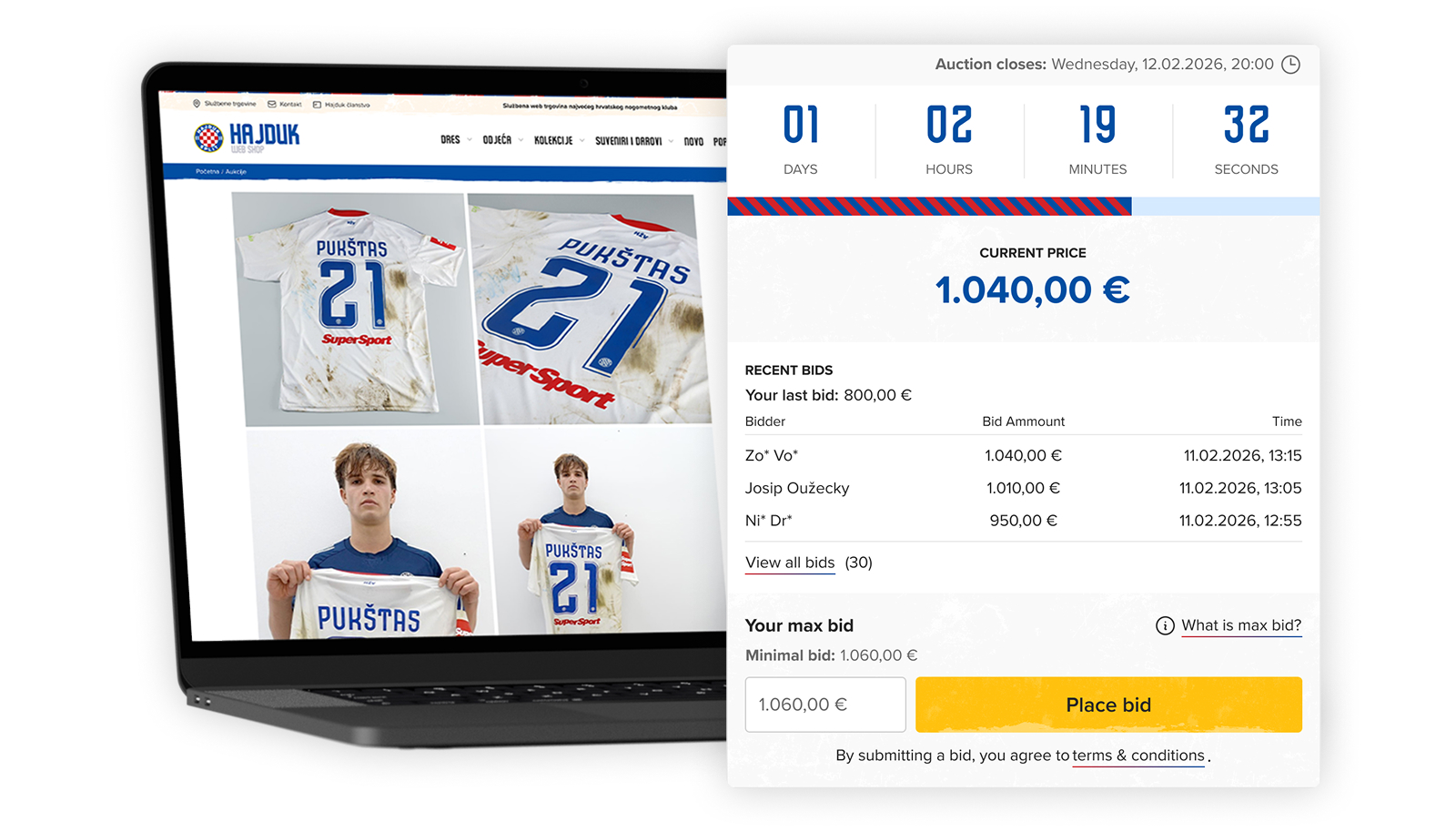
The response exceeded expectations.
Within the first day, the auction page recorded 4868 views. It became the second most visited landing page on the entire webshop. At one point, more visitors entered the site through the auction page than through the homepage.
News portals and sports media picked up the story and linked directly to the auction. During the auction period, that single URL generated 5654 sessions.
There were 35 competitive bids. The final price reached six times the starting amount.
For a single product page, this was launch-level traffic.
What the Analytics Revealed
The spike was clear. So was the drop-off.
- Day 2 reached 58% of launch-day traffic.
- Day 3 dropped to 20%.
- Day 4 recovered slightly to 24%.
Some decline is natural. However, day 3 also coincided with the launch of Hajduk’s Kraljica Lopte collection, which dominated social media attention and split the club’s promotional bandwidth at the wrong moment. The final hours of the auction received limited promotion.
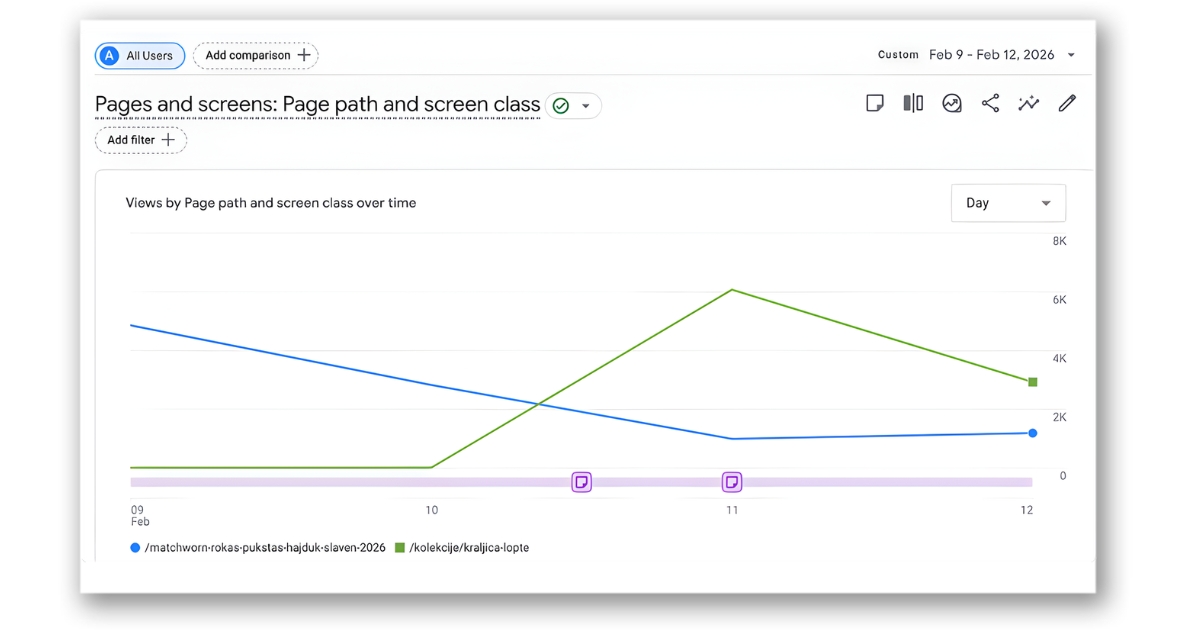
The lesson was immediate: auctions require protected airtime. The final hours matter as much as the launch. A coordinated push at the end would meaningfully increase engagement and last-minute bidding.
The broader data was still strong:
- During the auction period, the webshop generated 34699 sessions with 18308 active users.
- The auction page alone accounted for over 3200 active users.
- Roughly 16% of total site traffic focused on a single product page.
What Happened Next
With those lessons applied, Hajduk kept going. More auctions followed.
At the time of writing, Hajduk had run 9 auctions, generating a total of 358 bids and 11750€ in sales.
The trajectory matters more than the totals. The first auction was exploratory. Later ones were better timed and better promoted. Participation is increasing. The club has a repeatable process where listing a new auction takes minutes in the admin panel.
What We Got Right & What’s Next
In Hajduk’s case, the opportunity was clear: exclusive items with real scarcity were being sold in a fixed-price environment.
The solution was not to add complexity, but to introduce the right mechanism:
- Building the auction as a native Magento product type, rather than a microsite or plugin, proved critical. Auction products appear directly in category grids, they benefit from SEO visibility and share the existing infrastructure.
- Proxy bidding was the right choice for this audience. Fans can decide what they are willing to pay and trust the system to manage the rest without overcharging.
- Real-time updates increased engagement measurably. Average engagement time on the auction page was significantly above the site average. People were watching the auction unfold.
- The automated email flow, including bid confirmations, outbid alerts, winner notifications, and auction-ending reminders, removed operational overhead from the club’s team.
Now the focus shifts to optimization. The infrastructure is in place and the process is proven. From here, we work with the client to monitor each auction, learn from the data, and keep improving.
Beyond Sports Clubs
Auctions are a pricing mechanism for any merchant with inventory that carries real scarcity or emotional value. Fashion, art, collectibles. If the item is one of a kind, it belongs in an auction.
Merchants often undervalue exclusive items by forcing them into fixed pricing models. Price too high and the item remains unsold. Price too low and revenue is left behind. Auctions remove the guessing. The market decides.
Beyond pricing, auctions create momentum. They introduce urgency and a clear narrative arc. Shoppers return to check the status. Social content gains natural engagement.
The system is product agnostic. If your inventory has items worth competing for, the format works.
Thinking About Auctions for Your Magento Store?
If your Magento store offers exclusive, limited, or high-value items, the mechanism already exists. The question isn’t whether your customers would bid, it’s whether your store is set up to let them.
We’ve already built the infrastructure. Putting it to work is a conversation away. Reach out and let’s talk.