You’ve decided to bring your B2B sales online as a B2B eCommerce store – or expand what’s already there – and you’re about to talk to a few agencies. The instinct is to wait until the meeting and let the agency lead the discovery. After all, that’s their job, isn’t it?
Yes and no. The agency will absolutely run the discovery. But the quality of what comes out of it is set by what you bring in. Two merchants in the same industry, with the same budget, can walk out of the same meeting with completely different proposals – one vague and risky, one specific and confident – based entirely on how well-prepared the merchant was.
This post is a practical guide to what to prepare before the first conversation. None of it requires a consultant. All of it dramatically improves the proposals you’ll get back, and most of it is work you’ll need to do eventually anyway.
Why the Brief Matters More Than You Think
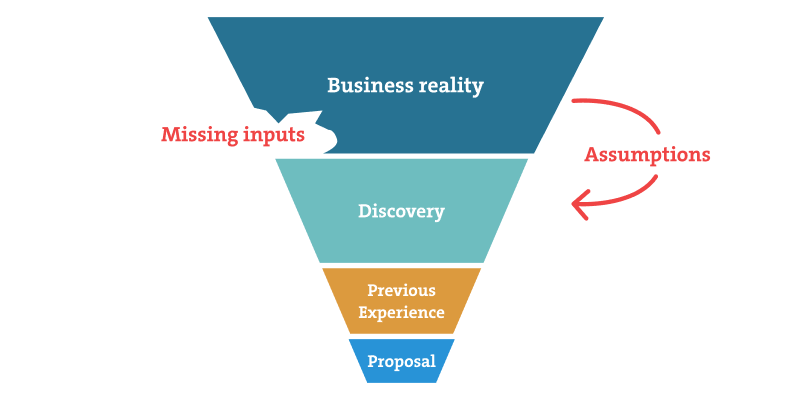
Agencies don’t quote on what’s true about your business. They quote on what they understand about your business after one or two meetings. The gap between those two things is where projects get scoped wrong, budgets get blown, and post-launch surprises happen.
A well-prepared merchant gets:
- More accurate proposals, because the agency isn’t padding for unknowns.
- Better-fit recommendations, because the agency can spot which patterns from past projects actually apply to yours.
- Faster decisions, because three weeks of back-and-forth get compressed into one good meeting.
- A genuine sense of which agencies are right for you, because their questions in response to your brief reveal more than any portfolio slide ever will.
You don’t need a 40-page document. You need clear, honest answers to the questions below, written down where you can refer to them in the meeting.
1. Business Context
Start with where you actually are, not where you wish you were. Be ready to answer:
- How do you sell B2B today? Phone, email, sales reps in the field, EDI, an old portal, a current Magento store, a mix of all of these?
- What’s the volume? Number of B2B orders per month, average order value, percentage of total revenue, number of active B2B customers, and your top-customer concentration (are 20 customers driving 80% of revenue?).
- What hurts right now? Specifically. “Sales reps spend 60% of their time on routine reorders.” “We lose two days every month reconciling pricing errors.” “Our biggest customer is asking for a self-service portal.” Concrete pain points lead to concrete solutions.
- Why now? A new contract, a competitor moving online, a leadership change, a system that’s about to be sunset, an ERP migration. The reason behind the timing shapes the right approach.
This is the foundation. Everything else slots on top of it.
2. Your Customers and How They Buy
A good B2B store is shaped around how your customers actually buy. Be ready with:
- Customer segments. Do you sell to large enterprises, mid-market, small distributors, end-users, or a mix? Each one buys differently and may need a different experience.
- Buyer personas. Who places the order – a procurement manager, a warehouse coordinator, an end-user with delegated authority? Who approves it? Who pays? Each role may need its own view of the store.
- How orders happen today. Walk through one or two real orders end-to-end: who triggers them, who handles them, where they get logged, when they hit the ERP, and when invoicing happens.
- What customers have asked for. Direct quotes from buyers – “I want to download my own invoices,” “I want to see my order history,” “I need to upload my SKU list” – are gold. They drive prioritization better than internal opinion.
If you can’t answer these clearly, the most valuable preparation step you can take is to call five customers and ask them. The insight you’ll get from those calls will outweigh almost anything else in the brief.
3. Commercial Structure
This is where most B2B project complexity hides – and where vague briefs lead to wildly different quotes from different agencies.
- Pricing logic. Who pays what? Is it standard list with discounts, customer-specific contracts, tiered by volume, market-based, or a combination? Where does this logic live today – in the ERP, in spreadsheets, in your sales rep’s head?
- Catalog complexity. Do all customers see all products? Are there private SKUs, restricted assortments, or contract-only catalogs? How is this managed today?
- Payment terms. Net 30, net 60, credit limits, payment-on-account, prepayment, mixed by customer? Who manages credit decisions?
- Geographic scope. One country, several? One currency, several? One warehouse, several? One legal entity, several?
You don’t need to design the solution. You need to be ready to describe the reality. The more honestly you describe the messiness, the more accurately the agency can scope it.
4. Your Tech Stack
The B2B store does not stand alone – it sits in an ecosystem. Be ready to map it:
- ERP (and version): SAP, Microsoft Dynamics, NetSuite, Sage, custom – whatever you run.
- PIM, if you have one: Akeneo, inRiver, or others.
- CRM: Salesforce, HubSpot, Dynamics 365, etc.
- Other connected systems: shipping, tax (Avalara, Vertex), payments, returns/RMA, marketing automation.
- Current eCommerce platform if you have one, with version and customization level.
- Where the source of truth lives for each major data domain – products, prices, customers, stock, orders. This single answer dictates 30% of the technical architecture.
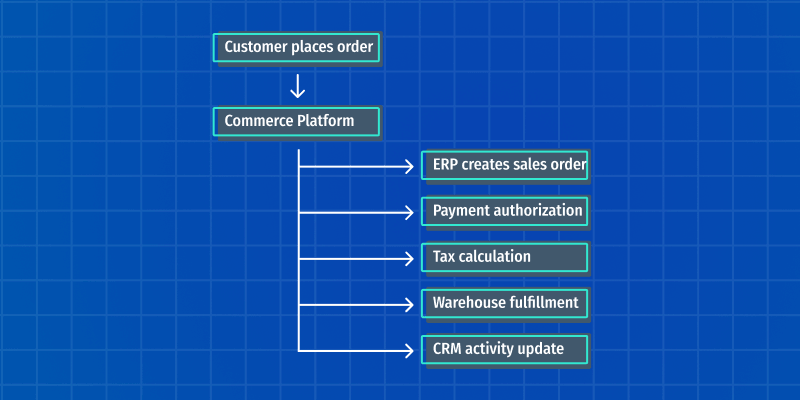
A simple diagram on a single page – boxes and arrows showing what talks to what – is worth more than ten paragraphs of description.
5. Stakeholders, Internal Reality, and Sales Team
The technical project will live or die based on the people around it. Bring this clarity:
- Who decides – final budget approval, scope sign-off, vendor selection.
- Who runs the project day-to-day on your side, and how much of their time it gets.
- Who uses the store internally – customer service, sales, finance, marketing, warehouse – and what each of those teams needs from it.
- Where your sales team stands on the channel. Are they excited, neutral, or threatened? Is commission tied to manual order entry? This single question changes the project more than any technical decision.
- Who will own the store after launch. If the answer is “we’ll figure that out later,” flag it now – the agency needs to know whether they’re building for an internal team or a “throw it over the fence” handoff.
Honest answers here are uncomfortable but essential. Agencies who hear them respond with realistic plans. Agencies who don’t, build for a fantasy version of your organization.
6. Goals and Success Criteria
This is where most briefs go vague. Resist that.
- What does “this worked” look like in twelve months? A percentage of orders moved to self-service, a number of sales hours saved per week, a customer adoption rate, a specific revenue target, a measurable NPS shift?
- Which metrics matter most to leadership? Operational efficiency, top-line growth, customer retention, margin protection?
- What’s your rough timeline? When is the first go-live, and when does the business need this working? Be honest about both the hard deadline (a contract, a system sunset) and the soft one (a leadership goal).
- What’s your rough budget range? You don’t need to disclose a number to the agency on day one, but you do need to have one internally. If you genuinely don’t know what good looks like, ask for a range based on similar projects – and be ready for the answer.
A merchant who can describe success in measurable terms gets a measurable proposal. A merchant who says “we want a great B2B store” gets a great-B2B-store-shaped invoice with no benchmarks.
7. Must-Have vs. Nice-to-Have
Every B2B project has a long list of features. Not all of them belong on day one.
Before the meeting, draft two columns:
- Phase 1 – what must be live at launch, because without it the store cannot serve its core purpose.
- Phase 2+ – what would be valuable, but can wait until you’ve validated the foundation.
Don’t try to make this list perfect. The agency’s job is to challenge it – they may push items from Phase 1 into Phase 2 because of integration risk, or pull items from Phase 2 forward because they’re cheap to do alongside Phase 1 work. But starting from a list lets that conversation happen. Starting from a wish-list does not.
8. Questions to Ask the Agency
The first meeting is also your evaluation of them. Bring questions:
- Have you shipped B2B Magento at the scale and complexity we’re describing? Ask for two or three specific examples, with names if possible.
- What’s your typical engagement model after launch? A good agency owns the post-launch growth – adoption, optimization, ongoing improvement. A weaker one wants to hand over and leave.
- What goes wrong on B2B projects, and how do you handle it? This question separates agencies who have done many projects from agencies pretending they have. The honest ones name specific failure patterns.
- Who from your team will actually work on this? If the people in the meeting aren’t the people who will deliver, ask to meet the ones who will.
- How do you think about data quality, sales team alignment, and customer adoption? If they only talk about features and code, they’re an implementation vendor. If they talk about adoption, you’re talking to a partner.

Common Mistakes to Avoid
Three patterns waste the first meeting:
- Bringing a feature list instead of a goal. “We need company accounts, contract pricing, and quote workflows” is a shopping list. “We want to move 60% of B2B revenue online in 12 months” is a goal. The first invites a quote. The second invites a strategy.
- Hiding the messy parts. Ugly pricing rules, sales-team politics, ERP issues you’ve been postponing – all of it will surface during the project regardless. Surfacing them in the brief is a free upgrade to the proposal you’ll receive.
- Treating the meeting as a one-way pitch. The agency is being interviewed. You are also being interviewed. A serious agency wants you to be a serious client. Acting like one – by being prepared – gets you better people, better thinking, and better commercial terms.
The Real Goal of the First Meeting
The first meeting is not where you sign anything. It’s where you and the agency decide if you can work together – on this project, at this scale, with this much honesty about what’s hard.
The merchants who get the most out of these conversations are the ones who arrive with a clear picture of where they are, what hurts, what they want, and what they don’t yet know. The agencies worth working with respond to that with substance – sharper questions, sharper proposals, and a sharper sense of whether the fit is right.
If you’re getting ready to talk to agencies about a B2B project – or you’d like a sounding-board session before you do – drop us a line. We’re happy to help you prepare, even before there’s a project on the table. A good brief is the start of a good project.