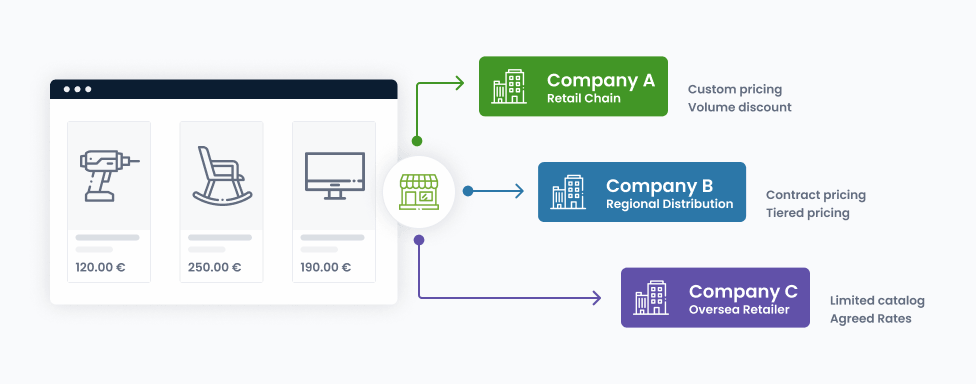
Not every B2B customer should see the same storefront. A distributor selling to a national retail chain and a small independent shop rarely buy under the same terms. One might have a volume based contract that unlocks a lower price. The other might only be able to order from a specific, agreed assortment. For instance, a manufacturer supplying both a regional partner and an overseas reseller may need to show each one a different set of products, at a different price, without either one seeing the other’s terms.
In practice, most businesses solve this the hard way. Sales reps keep private spreadsheets. They apply special prices manually at checkout, or worse, over the phone. Some merchants even build a second website just to serve one large account. It works, until the number of companies grows and the manual effort behind it grows with it.
Shared Catalog exists to solve exactly that problem. Instead of one web shop with one price list, it lets a business define multiple catalogs, each with its own products and its own pricing, and assign them directly to specific companies. As a result, every company logs in to what feels like its own private store, without the business needing to run a separate platform for each one.
Why Shared Catalog Exists in B2B
The previous post in this series, “What Every Web shop Needs Before Introducing B2B Functionality“, described customer specific pricing and catalogs as one of the essential building blocks of B2B eCommerce. Shared Catalog is what makes that building block work in practice, once a business has more than a handful of companies to manage.
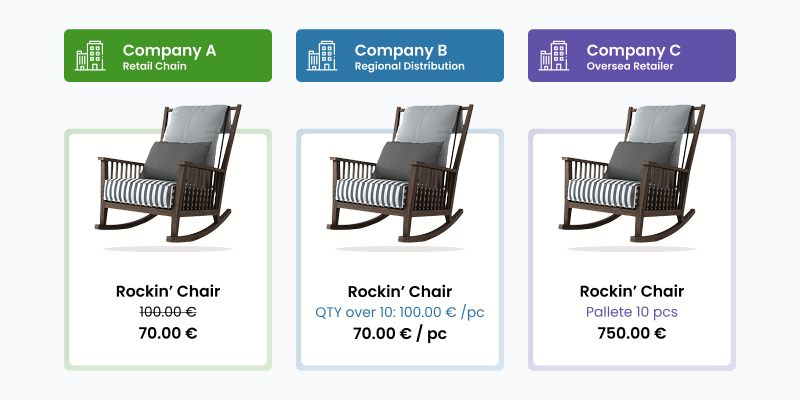
Specifically, two problems usually push a business toward this. The first is pricing. Negotiated discounts, volume tiers, and long term contracts mean that no two companies necessarily pay the same amount for the same product. Beyond that, this pricing information is sensitive. A distributor would not want one client to see the discount given to another, since it could undermine both relationships.
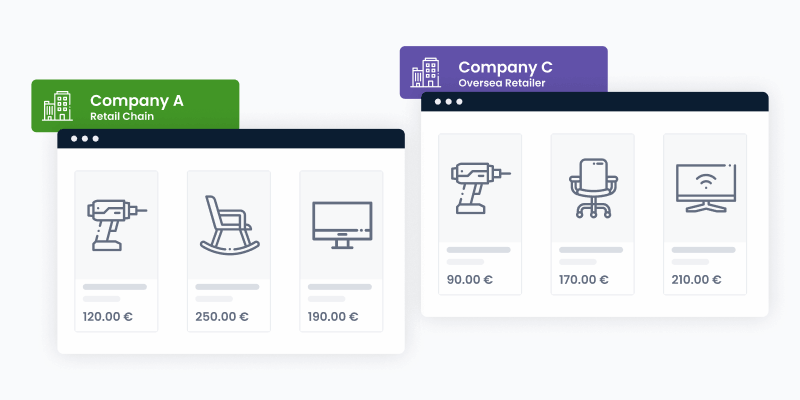
Beyond pricing, the second problem is assortment. Not every company should see every product. For example, a business might reserve certain items for an exclusive partner, restrict a regional distributor to products cleared for their market, or hide discontinued lines from everyone except a client still working through old stock. In other words, the catalog itself needs to change depending on who is looking at it, not just the price tag.
Without a structured system, businesses handle both of these problems manually, through spreadsheets, emails, and sales reps applying rules from memory. That approach holds up for a few accounts. However, it does not hold up for dozens.
How Shared Catalog Works
A Shared Catalog setup starts with one public catalog. This is what guests and any customer without a special agreement see, the standard product range at standard prices, just like a typical web shop.
On top of that, a business can create any number of custom catalogs. It builds each one around a curated set of products, selected by category or individually, along with its own pricing. That pricing can be a fixed price per item, a percentage discount off the standard price, or volume based tiers, depending on what the business has actually agreed with that customer.
A business then assigns each custom catalog to one or more companies. Once it makes that assignment, everything happens automatically. A buyer from that company logs in, and the storefront reflects their agreement without any extra steps. They see the products available to them, at the price they negotiated, without needing to ask a sales rep or remember a discount code. Meanwhile, another company logged in at the very same time sees an entirely different catalog, with different products and different prices, and has no way of knowing the first one even exists.
What This Means for Buyers and Sellers
For buyers, the benefit is a cleaner experience. Instead of browsing a full catalog and wondering which items actually apply to them, they see only what is relevant. Their price is simply the price shown, not something they need to negotiate again at every order. This matters most for repeat buyers, who order often and expect consistency every time.
For sellers, the benefit is control at scale. A business makes catalog and pricing changes once, and they apply everywhere immediately, instead of repeating them across spreadsheets or passing them to a sales team one email at a time. Equally important, sensitive pricing stays properly separated between clients, which protects both the relationship and the negotiation itself. And because a business simply assigns catalogs to companies, adding a new client does not mean building a new website. It means creating one more catalog inside the same system.
Over time, this also gives a business a clearer view of its own pricing. Instead of scattered exceptions living in someone’s inbox, every negotiated deal lives in one place, tied to the company it belongs to.
Where Shared Catalog Fits in the B2B Journey
Not every B2B web shop needs Shared Catalog from day one. If a business sells to a small number of companies with roughly similar terms, a simpler setup works fine. But as the number of companies grows, and each one negotiates its own products and prices, the cost of managing that by hand becomes real, in lost time, inconsistent pricing, and mistakes that reach the customer.
Indeed, Shared Catalog is one of the capabilities that sits on top of the foundation described in the first post in this series. Company accounts give a business the structure to organize its customers. In turn, Shared Catalog gives it the means to treat each one differently, without extra platforms or manual workarounds.
Ultimately, no two companies buy the same way in B2B. A web shop that treats them all the same eventually becomes the bottleneck instead of the solution.